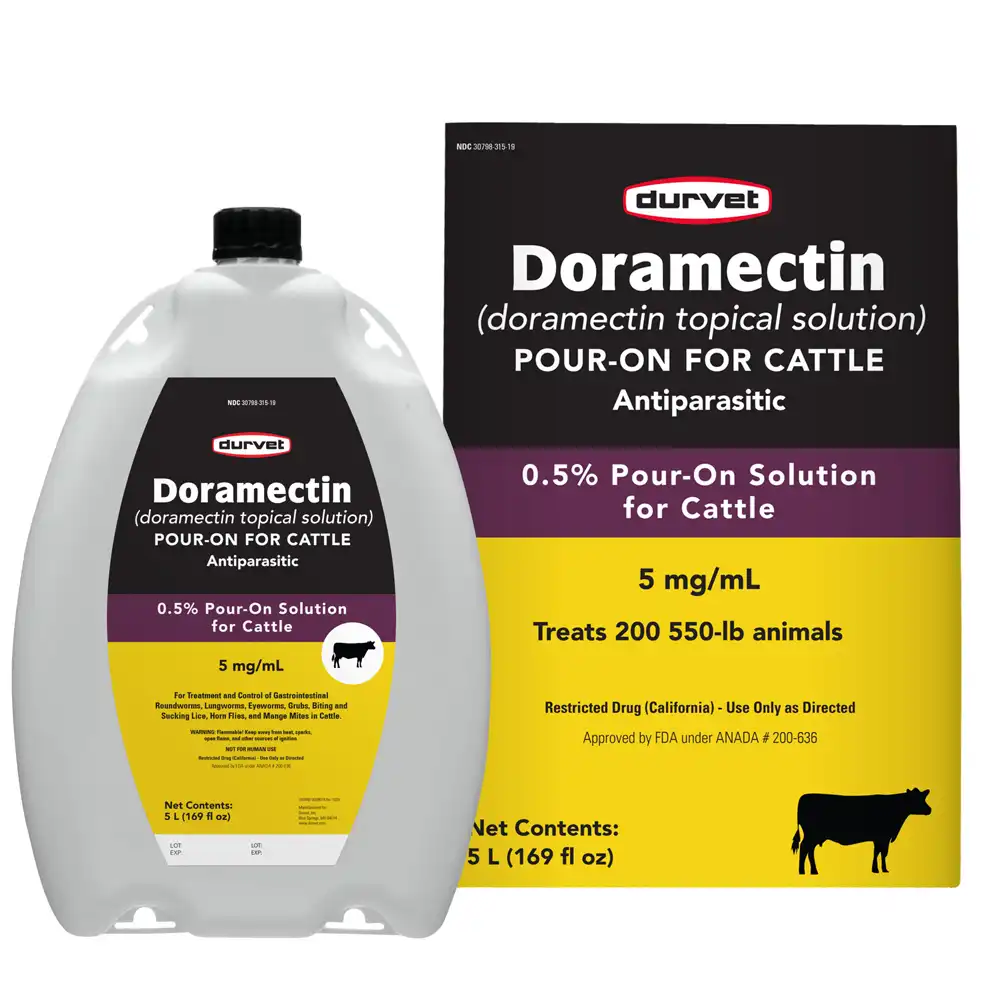
The industry’s #1 selling pour-on deworming brand contains the active ingredient moxidectin, which controls 33 parasite species and stages while remaining dung beetle and earthworm friendly.¹﹐²﹐³ Cattle parasites can cause a host of problems in cattle from reductions in milk production, reproductive performance and growth rate to increased disease susceptibility.⁴ This can occur even with subclinical infection when symptoms may not be noticeable. Researchers have estimated, without dewormers, cow-calf producers would sacrifice more than $165 per head in lost returns.⁵ Overall, for the entire beef production system, the impact of eliminating dewormers on break-even prices totaled $190 per head.⁵
- Elanco Animal Health. Data on File.
- Suarez, V., Lifschitz, A., Sallovitz, J., et al. 2009. “Effects of faecal residues of moxidectin and doramectin on the activity of arthropods in cattle dung.” ScienceDirect.72 1551-1558.
- Environmental Assessment. Cydectin® moxidectin 0.5% Pour-On for Cattle. Fort Dodge Animal Health, June 1997.
- Smith, R., Rogers, K., Huse, S., et al. 2000. “Pasture deworming and (or) subsequent feedlot deworming with fenbendazole. Effects on grazing performance, feedlot performance and carcass traits of yearling steers.” Bov Pract. 34(2):104-114.
- Lawrence, J., Ibarburu, M. 2007. “Economic analysis of pharmaceutical technologies in modern beef production.” Proceedings, NCCC-134 Conference on Applied Commodity Price Analysis, Forecasting, and Market Risk Management; 10.
- Losey, J., Vaughan, M. 2006. “The economic value of ecological services provided by insects.” BioScience. 56(4):311-323.
- Sallovitz, J., Lifschitz, A., Imperiale, F., Virkel, G., Lanusse, C. “A detailed assessment of the pattern of moxidectin tissue distribution after pour-on treatment in calves.” Journal of Veterinary Pharmacology and Therapeutics. 2003;26(6):397–404.
Indications:
Cydectin Pour-On when applied at the recommended dosage is effective in the treatment of internal and external parasites. See product label for a full listing of parasites controlled.
Cautions:
Keep Cydectin out of reach of children.
When used according to label directions, neither a pre-slaughter withdrawal period nor a milk discard time is required. Do not use in calves to be processed for veal. For external use only. Do not apply to areas of skin with mange scabs, skin lesions, mud or manure, Cydectin Pour-On is not recommended for use in species other than cattle.
Storage:
Store product at or below room temperature. Avoid prolonged exposure above 25°C (77°F). If product becomes frozen, thaw completely and shake well prior to use.
Administration:
Pour-On: Administered directly to the hair and skin along the top of the back from withers to the tailhead at 1 mL per 22 lbs. of body weight.